PLAYLIST PRESENTED BY

Why 98% of Aspiring Buyers Never Close (And How to Be in the 2%)

Description
Athena breaks down why most entrepreneurship through acquisition journeys stall before the finish line, from copycat deal boxes to slow deal velocity. Learn the real funnel math behind a signed LOI, how to match yourself to the right business instead of chasing unicorns, and the system first-time searchers need to compete against private equity, strategics, and seasoned operators. Essential viewing for searchers, SBA lenders, and ETA service providers.
Recent Videos
Transcript
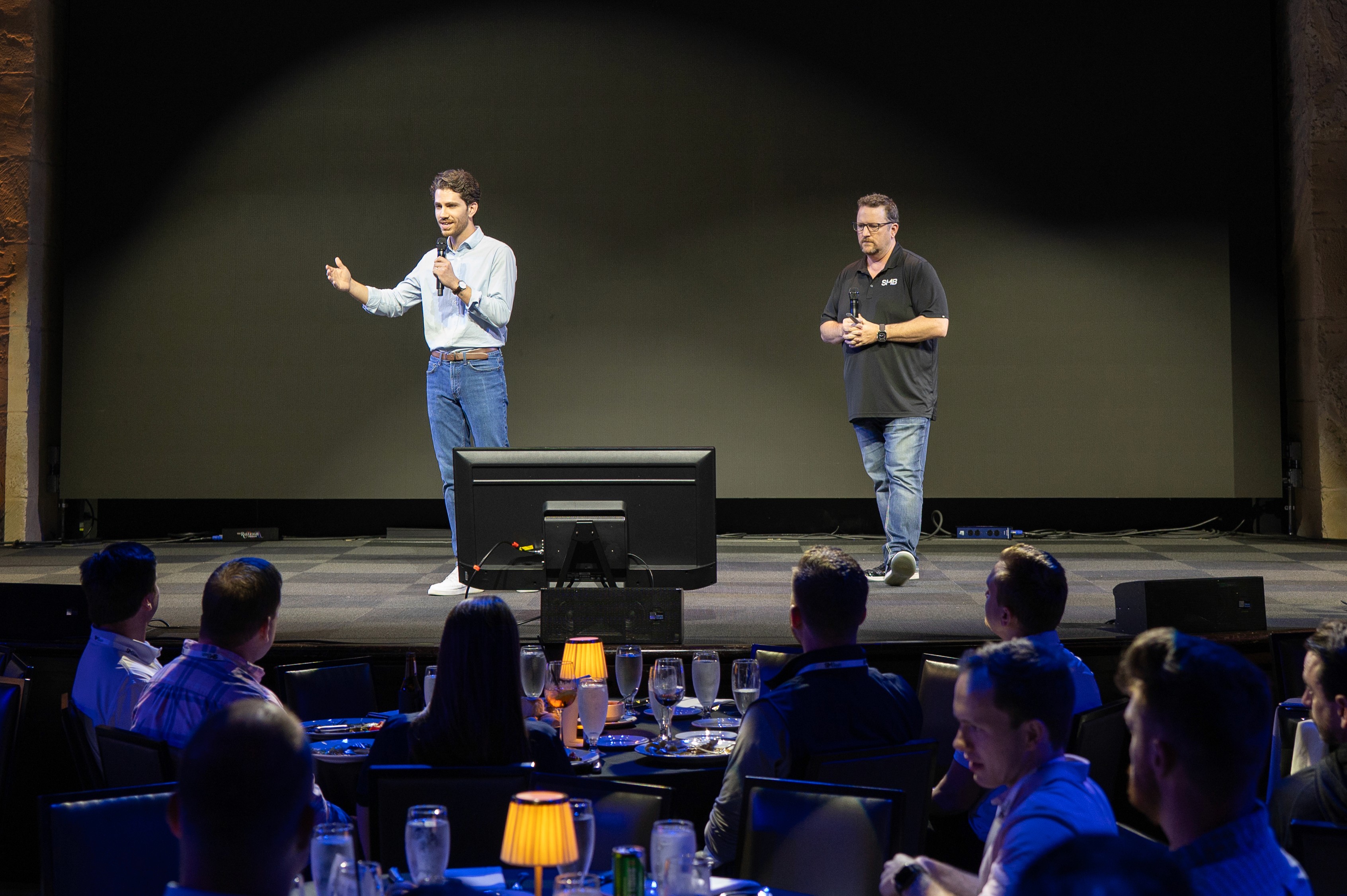
In the last few months alone, we've gotten 70 LOIs out from our clients. Ryan Cash at the back there that's filming is responsible for 50 of those in the last eight months. Nine of our clients are currently under LOI. We have another nine negotiating LOIs as we speak, and we have a 20X industry close rate.
Kevin gave you a little intro, but I am a five-times founder. I have the battle wounds to show it. We're all wanting to buy businesses because we know how hard zero to one is, but I can't seem to get away from it. I was a business consultant and also a lecturer over at the McCombs School of Business in Austin, Texas. And I raised $3 million in five days over Labor Day weekend to acquire a business. I'll tell you more of that later.
Get your pen and paper out because this is going to be an active session. Three questions you should ask yourself before you start your search. We're talking Deal Sourcing 101. I'm going to assume all of you are doing this for the first time and you're here because you want to learn how to start your search. I'm going to disrupt a little bit of the noise that you've been hearing on the internet.
Two real client stories to kick us off. Client one, we found him an off-market HVAC business, stable and growing revenue, $750,000 in SDE. He got it under offer at a 3X multiple. This was in those glory days when the owner could hold the license and a percentage in the SBA loan without personal guarantee, and the owner agreed to that. He was an awesome owner who loved our client. Everything was going his way. And then at one point, he just walked away. None of us could figure out why. The owner himself said, "You know what? I just don't think he's ready."
Buyer number two, she loved woodworking, and we found her a custom cabinetry business. Over a million in SDE, 3.3X multiple. The owner was lovely, kept agreeing to things to make the deal more comfortable for her. She had quit her job to do the search, which I advise against. It puts you in a place of desperation. An unexpected tax bill hit. When she got those term sheets, the numbers started feeling more real than they did in theory. She walked away.
What was wrong with those deals? What was wrong with those businesses? That's what we focus on. We're looking at the businesses and figuring out what's wrong with them. The deals weren't the problem. Those were great businesses. So I started getting obsessed with: what is it when you get everything that you want and people still walk away?
I learned this stat from my friends over at Baton, who have thousands of data points. 98% of people who say they want to buy a business never do. That means 2% actually buy a business. It's not a deal flow problem. There are 47,000 businesses on BizBuySell right now. So what's going on?
Being a business owner is the hottest club in town right now. Everybody wants in. This reminds me of my startup days. I used to help thousands of startups through the process, and I'd have people come to me year after year telling me they were starting a business, they had this idea, they were researching and thinking about it. But they didn't actually do anything to start that business. Now we're seeing that in business buying.
You've got people like Clint and Jackie who have the deal that you want to get into, and you need to prove to them that you are ready and able to get into the club. It's not like the rope's open and they say, "Oh, hey, you want to buy something and spend some money?" That's not how it works.
Buying a business is like an Ironman. Most people are turning up completely untrained for what is going to be the most harrowing experience of your life if you actually get to the finish line. If you want to buy a business, this is not something you can do casually.
The internet is telling us that business buying is one of the greatest things ever, that you can skip off happily off the beach and sit there while cash just lands in your bank account. There's a reason why in the movies they don't show us what happens after they get married. I have not met a single business owner that has not had the most crazy experience and heart-wrenching things go through it. You're going to be challenged and tested in ways you've never experienced before.
So that brings us back to: what was wrong with those deals? You've got to ask yourself, am I actually ready to be a business owner? Get your phones out, scan that code. There's a 20-question assessment. Answer those questions honestly as who you are now, not who you aspire to be. First instinct, be honest with who you are.
Kevin and I were going through this in our prep call. Kevin is a lawyer. There are different traits we want to see in owners. Kevin's got 100% on a lot of those, but when it comes to being a risk-taker, do we want our lawyer to be a super big risk-taker? No. Do we want them to be totally okay with ambiguity? Absolutely not. His profile is wired to be in ownership. Growth mindset, the fixer instinct is amazing because that's what you want in your ETA lawyer. When a challenge comes up, they're going to help you figure out how to overcome it. Regardless of what your results are, that's how you're uniquely wired, and some things are good and suited to you.
The theory behind this was: I have these great people who have the money. We've found them the perfect deal. The deal's going well. They say they want this, and yet they decide not to move forward. Service providers, lenders: how many of you have worked on a deal that was going great and the buyer just walked away?
A mentor of mine, Darius Mirshahzadeh, who scaled businesses to billions, told me to check out Gino Wickman's book, "Entrepreneurial Leap." Gino Wickman is the founder of EOS, an amazing operating system to plug into businesses. He outlines six traits you need as an entrepreneur.
Some of these things aren't necessarily good traits to have when you have friends and family that are not wired this way. For example, visionary. All of us want to be the visionary. You know what you do on vacations when you rent an RV and try to do a three-day weekend with your partner, and you're like, "How much are we spending on this RV? Wait, what's the ROI? If I buy an RV and then I rent it out, how much will I be making?" That's how I spent my three-day weekend with my boyfriend. You need that when you buy or start a business because somebody has to see the potential.
Do you have the ability to keep going when it sucks? Because it's going to suck. I don't care what business you buy. I don't care how long your search takes. Last year here, they were saying two to four years you should lock in for your search. You work with us, it's going to take 12 to 18 months. That's real.
Ambiguity tolerance, uncertainty tolerance. How are you when you don't have 100% of the information? This is where most people fall down. They need 100% of the information to take the biggest risk of their life, and in business ownership, you never get that. 60% at best, and you have to make a decision knowing all your team's livelihoods are on the line, your family's home, if you took out an SBA loan.
Do you have a growth mindset? Are you a person who, when challenges happen, thinks, "What can I do to get better?" as opposed to, "The whole world's against me." Only 3.7% of adults in the US are business owners. This is not a common thing, and it's for a reason. There is absolutely no shame in a paycheck. There's no time off. There's no not thinking about your business, and there are so many problems and challenges that come up, and you are the one that has to solve them.
There's this idea that business ownership is an escape. If you're running away from a job you don't like and a boss that sucks, you're running towards "the grass is always greener." But there are some of us that are in pain if we aren't driving, if we're not building. I'm one of those people. I'm in pain if I don't have a business to run that I can build, and there's a lot of pain that comes with that. Every single trauma I have suffered comes up. I have to face it every day as a business owner. Most people don't want that, nor should they.
The people we serve are owners trapped in employment. You know who you are because every day you're in the coffee shop, in the business, thinking, "What business could I start? I need to drive." Maybe you started lemonade stands or a paper route or mowed lawns as a kid. We're in pain when we're in employment.
So the question you need to ask yourself before you start looking at businesses to buy is, are you truly wired for this? Are you up for the suck that's going to come during your search and after? Every single person I talk to that's bought a business, I ask, "How's the J curve going?" Even if they keep revenues stable, they still feel it for two to four years afterwards. It sucks, but it's also one of the most gratifying things you'll ever do if you're wired that way.
The next thing you need to do is stop scrolling and start matching to businesses. Get your pen and paper out. Draw a line down the middle. Column A: write down your deal box right now. What are the things you want in a business you are buying? Revenue size. High customer retention. Profitable. These are good characteristics.
Column B: think about your unique superpowers. What is something you are good at that your friends know you for, that you light up when you're in the right work environment? For me, I can see into the future and every scenario. I'm really great at strategy and thinking ahead. It's also an affliction because when we try to go on that RV trip, I'm like, "Where are we stopping? What if the power goes out?" I can't just chill. Another superpower is relationships and EQ, sensing where people are at. Hello, childhood trauma. I'm hyper-sensitive, and now it's my superpower. I love educating people. I love pulling out what people didn't know was in themselves. So when I know these things about myself, I can look for businesses that match.
Now go back to your deal box and star every characteristic you wrote down that you have personally had a conversation with a broker or a seller to vet and test. Because your deal box is a theory. What of those assumptions have you tested with a real conversation? Question mark for everything you heard should be in your deal box that you haven't had a conversation about. Reading SIMs doesn't count, that's research. Real vetted conversations where you looked under the hood. I'm guessing there are more question marks than stars.
That's okay. You're doing this for the first time, and there's all this information that we hear of, like make sure there's not a lot of customer concentration and stable growing revenue. I get dozens of people contacting me every week. They send me their deal boxes.
Searcher one: services company, $500K to $900K SDE, repeatable customer base, established operations and team, owner open to transition support. Services, strong operational components, generating $600K to $2M in SDE. Services, $250K to $750K SDE, stable cash flow, strong fundamentals, operational infrastructure. Turnkey businesses. Anyone noticing a pattern? They all look pretty much the same. I could rattle off most of your deal boxes now. Over $500K in SDE, stable growing revenue, in existence for at least five years, recurring revenue, owner out of the day-to-day. Are you all exactly the same person? No.
So what's going on with your deal box? Why are you all searching for the same thing? You go to a broker and they ask, "What are you looking for?" And as a first-time searcher, you say, "I don't know, but I have to say something, so let me pull some stuff off the internet." It is a messy calibration process. What you should be doing is taking everything you think you want, going out, stress testing it, iterating, calibrating, time and time again to actually learn what will be a good fit for you.
The deal boxes you all have are the equivalent of coming to me and saying, "I want a 6'4" blonde, blue eyes, has a trust fund, works in finance." That's about 0.000004% of the population. You all want the same businesses in very small supply and high demand. Rather than looking for that unicorn, look at yourself and figure out, "What buyer am I? What owner am I?" so you can go out and find that match.
Most people don't actually want to marry the guy with the trust fund who works in finance. As a matchmaker, when you come to me with that, I say, "Here's a 5'10" brunette with the same sense of humor and values. Why don't you have a conversation?" Your business, you have probably already looked at. You just scrolled past it because you're looking for the unicorn instead of figuring out who you are and becoming the buyer you need to be to match that business.
Match or mismatch? How does the deal box reflect who you are and what your superpowers are? What environment do you excel in? Some people hate remote work. I don't want to ride around in a truck every day. I like remote businesses because I can seal myself off from the world and do my strategy work. Put me in a cubicle and I want to die.
Why do you want to do this? What does your life look like 10 years from now, and how does the business fit into that? When you sign the SBA loan, that's a 10-year commitment. We don't even sign up for jobs that long. And you're putting your family's house on the line. You want to stop scrolling and start matching, and you do that by figuring out what owner and buyer you are. Question two is, "What's my match?"
Now, how many deals do you think you need to scan to get one signed LOI? How many deals do you need to match? How many do you need to have serious conversations with the broker and seller, do your financial modeling on, to get a signed LOI? How many LOIs do you need to send to get one signed?
Here are real numbers for our clients. On average, we have to go through 10,000 listings. We have to match about 500. We need to sign 152 NDAs, review almost 100, have serious conversations with 23, send 4.3 LOIs to get one signed. That's the kind of volume you need. This is competitive. Look at how many of you are here. The internet has caught wind of the hottest club in town, and most of you are signing a couple of NDAs a month.
Now, signed LOI doesn't mean closed. 3X that number, because on average, you're going to go through two to three signed LOIs before you actually close on a business. About 30,000 deals scanned, 1,300 matched, 650 NDAs signed, 300 SIMs reviewed, 81 serious conversations, 9 to 14 LOIs sent to get 2 to 3 signed to close.
And I told you I think you should stay in your job while you do this. This was not set up for you to win. How are you supposed to do this when you work full time? Most of you come to me and say, "I want to get an offer in three months and close within six." Even if you work with someone that can help you, this is your first time doing something people get MBAs for. It should take time if you're signing a multimillion-dollar personal guarantee and putting your home on the line. So extend your timeline first and foremost, and treat it like something real.
This is Lady EBITDA. We created her when we realized we had hundreds of data points on every client, and one human couldn't remember all of those. So we started developing AI over a year ago to scan thousands of listings every month and match to hundreds of parameters. She has cut down the SIM wastage. When we had a human at the front line, we were throwing out 75% of the SIMs. Now it's down to 25%.
Deal velocity. Write this down. Single biggest factor in whether you win or not. The ability to go from NDA to LOI quickly. It's the velocity at which you're moving things through. To win, you have to do it as quickly as possible.
We analyzed 50 LOIs that went out from our team, what made them win, what made them lose. My real estate folks, stop going in 10% under asking. You're just going to lose. 10% over asking on average is what gets it closed. You can structure creatively. Please go to the financial modeling session tomorrow. There are things you can do to protect your downside, make sure it's SBA fundable, and also be competitive. But time, the difference between winning and losing, was only five days.
Most of you take two to four weeks from seeing a deal to getting on a call with a broker. You maybe get in front of a seller, and then you say, "Now I'm going to start my financial modeling and figure out whether I want to put an LOI together." By the time you get that together, that deal's gone. You need a system that allows you to move at speed. Nights, weekends, every single day, you're working your pipeline and moving things forward. Speed not only gets you first-mover advantage, it conveys confidence to that broker and seller. Make no mistake, brokers are vetting you. Everything you do signals whether they think you can close.
Components of a winning system: Scan as many deals as possible. Top of funnel, moving it through. Layer on that this is your first time, and you need even more volume than somebody in private equity who knows what they're looking for. Organized pipelines, tracking everything. A spreadsheet is not enough. Professional email and buyer profile that shows you, not the "such and such holdings" or "blah, blah, blah ventures." You're not a fund. You're you, and you have your own superpowers. Brokers and sellers would rather hear that from you and see you're doing your homework, moving fast, and have good teams behind you. Templates for everything, automations. A repeatable process to vet and get a yes or no quickly. Use your deal box to vet. Don't get shiny object syndrome. A submission process that helps you win and is fundable.
Question three: Am I treating this like I am already a business owner? Am I installing all the things into my search that are going to help me win?
Off-market is not a better option. It's a sourcing channel, but as you heard Chris say, it's not a good channel, especially if you're a first-time buyer. It's the blind leading the blind. I have a client right now who got a 2X multiple on over a million dollars in adjusted SDE with some real estate, the dream, off-market. 2X, under offer in June of last year. He has still not closed because he's acting as broker and buyer when he doesn't know how to do either. It takes a long time, and most people don't get to the finish line. You want an incentivized intermediary who knows what they're doing. Even if you don't like Mr. Broker, they're going to keep things moving and be your best advocate once you get an offer.
You didn't lose the deal. You were never in the race. You've shown up to the World Series of Poker thinking you're going to get to the final table, never having played a hand. You're up against my team, against everybody else in this room, against private equity, against people that have bought businesses before, against strategic investors. Chris Moneymaker, okay, it does happen. You have to train to win. The way you get better at poker is playing hands. So stop researching and start taking action to vet those theories. Your deal box is a theory.
My $3 million lesson. I found ETA, just like you, and thought it was the best thing in the whole wide world. I did everything I could to source businesses. I wasted time off-market for a very long time by myself, and I ended up finding an off-market deal in a city I'd never considered, in an industry I hadn't considered, with an $8 million asking price, way above what I thought I could do. I started with the gateway drug to business buying, looking at laundromats and car washes. But I realized I didn't see myself in those businesses, and I found this business that was literally made for me.
I met the owners and we got along so well. Out of 14 offers, I was the only person allowed to meet the owners in person. The broker even loved me. I was a chosen buyer. He said, "Athena, we love you, but we need to know you can finance this deal." I said, "Don't we figure this out after we get under LOI?" "No, Athena, there are other people with money. This is a big deal. Go to your lender, get him to sign off." The lender said, "This is an air ball and over SBA limits. You need $3 million." I said, "Cool. I can raise $3 million."
I went back to the broker and asked for time. At the time, that's how audacious I was. He said, "Athena, there are other offers. I'll give you till Wednesday." It was Friday before Labor Day weekend. I had nothing to lose. I went out that weekend and worked my tail off. By 5 PM Tuesday night, I got my final commitment signed, sealed, delivered, $3 million from investors ready to go. The lender said, "This is a deal I want to be a part of." Long story short, someone came in $2 million enterprise value more than I did. The owners actually deliberated about this. They chose the higher offer. Knowing what I do now, I could have structured it to match, and we wouldn't even be here today, or I'd be up here as an operator. This system was not set up for first-timers to win.
You need to surround yourself with as much information as possible. I was the right owner of that business, but I was the wrong buyer. What you need to commit to is becoming the right buyer and the right owner at the same time. Ask yourself, "Am I wired for this? What's my match? Do I have a winning system?" The 2% who close aren't luckier. They just set themselves up to win.
I'm going to leave you with some gifts. Scan that QR code. The assessment you just took, a deal velocity scorecard so you can assess whether you're moving quick enough and at enough volume and identify bottlenecks. An EQ playbook. I didn't get to the EQ side of things, but it's huge. Will and I hosted some webinars on Acquiring Minds for EQ. Most of you are showing up like a jerk, and they don't choose you for that. On top of all the technicalities, you also need to learn how to sell, negotiate, and be a likable person.
Lastly, the setting-the-destination exercise. If you don't know where you're going in your life, you are going to get lost. So many people can't picture what a happy life looks like for them. This exercise is essential because when you know where you're going, then it's much clearer how to get there. The journey might change and the destination might adjust. But I can picture what my happy life looks like, so every choice I make helps me move towards that or away from it. Before starting your search, you need to picture that, and if you have a spouse, you need to make sure they have the same vision.
Q&A:
Question: What is the average time from when buyers start research to a signed LOI?
I can only speak for when they work with us. On your own, it's much longer. I've had clients get under offer within the first two months of working with us, because we spend a lot of time upfront getting clarity on what their deal box looks like. A lot of people come to us having tried to do it on their own and they don't want to do it anymore. Two to six months on average is usually when people get under LOI working with us. If you're doing it on your own, probably a lot longer because you're learning it and don't have support. We deliver the matched deals, so we skip the upfront work.
Question: Is your suggestion that the narrower the buy box, the better?
Nope. How could you know what industries you want unless you have direct experience? For most first-time searchers, we're industry-agnostic. The industry and the brokers don't want us to be agnostic, so we're in that cycle. The way we do searches is we actually eliminate the nos. I had a client who said, "Nothing in waste. My family worked in waste. Never want to work in waste again." Okay, cool. Your absolute deal breakers we eliminate, and then we leave everything else open. We have a client right now who's under offer. She has a great background working at large fast-moving consumer goods brands with retailers. We happened to find a business that's a company she is a customer of. She didn't say, "I want you to buy this kind of company." We eliminate what is not a good fit so we can leave ourselves open. I never had property management on my list. But the way they built their business was so aligned with so many things about me that I saw myself in it. Be really clear on your nos, and really sit with what your superpowers are. Think back to your career or moments in your life that you're really proud of. What environment was around? What were you doing? So you can spot it when you see it.
Question: If you score well on the buyer readiness assessment, does that necessarily mean you're ready in terms of all the infrastructure? How do you know when you're actually ready to start sourcing, and what would you recommend doing to get there?
Readiness is the internal wiring. To actually get off the block, start with the setting-the-destination exercise so you know where you're going. Then work back. Either build infrastructure or look for solutions. There are people that can help you skip the gap. There are really good accelerator programs. Start actually looking at deals. Sign NDAs, review the SIMs, have a conversation. Most people hide behind the research. You'll learn a lot about yourself and the process by getting the broker to grill you. Most brokers I know, if you show up and say, "Hey, this is my background. I am wired to be an entrepreneur. This is why I love this business. Can I ask you a few questions about it?" they'll respond well. You learn by getting your reps in. Don't hide behind the SIMs. Get out there and have conversations with real deals.
Question: How do you differentiate outreach to business owners off-market?
With off-market, owners are probably getting about 50 emails a day right now. It's not a channel I recommend if you're doing this on your own. If you're insistent on it, use a Dream 100 process versus blasting everybody. Go in your neighborhood, think of those qualities you want, look at businesses you really admire, get a short list, and try to have a face-to-face conversation. Hiding behind email, everybody's doing email and calls right now. But you're still going to spend a lot of time trying to get their financials. They always want 10X what their business is worth. Their financials aren't ready. So strap in for a much longer process, and you may spend a bunch of time only to find out they're not profitable or a good fit. If you're a first-timer, it's probably better to go on-market and learn how to stand out. It's not that hard. With influencers telling people they can do this with no money down and 100% seller financing, if you show up having done your homework, look like a credible buyer, and get your pre-qualifications from the amazing SBA lenders here, that's a better strategy.
When you go to owners, you want to be uniquely you, tell them why you love their business, what connects you to it, and hear their story. The first thing I always ask sellers is, "I know this is a serious conversation, but you have to tell me the origin story. It's my favorite part." Don't you want to hear how they started it and the 20 years they went through to get it to that point? They will reflect on the fact that you were the only person to ask that. They start seeing you as their heir because you cared about how it started, how they got it there, and the pain and suffering they went through. EQ all the way.
Thank you so much. I'll be here the rest of today, so please come find me.